Apartment hunting is a full-time job
Nobody warns you how much time and energy it actually takes. It's not a weekend project. It's weeks of sustained attention, and most people underestimate it badly.
Haus Together
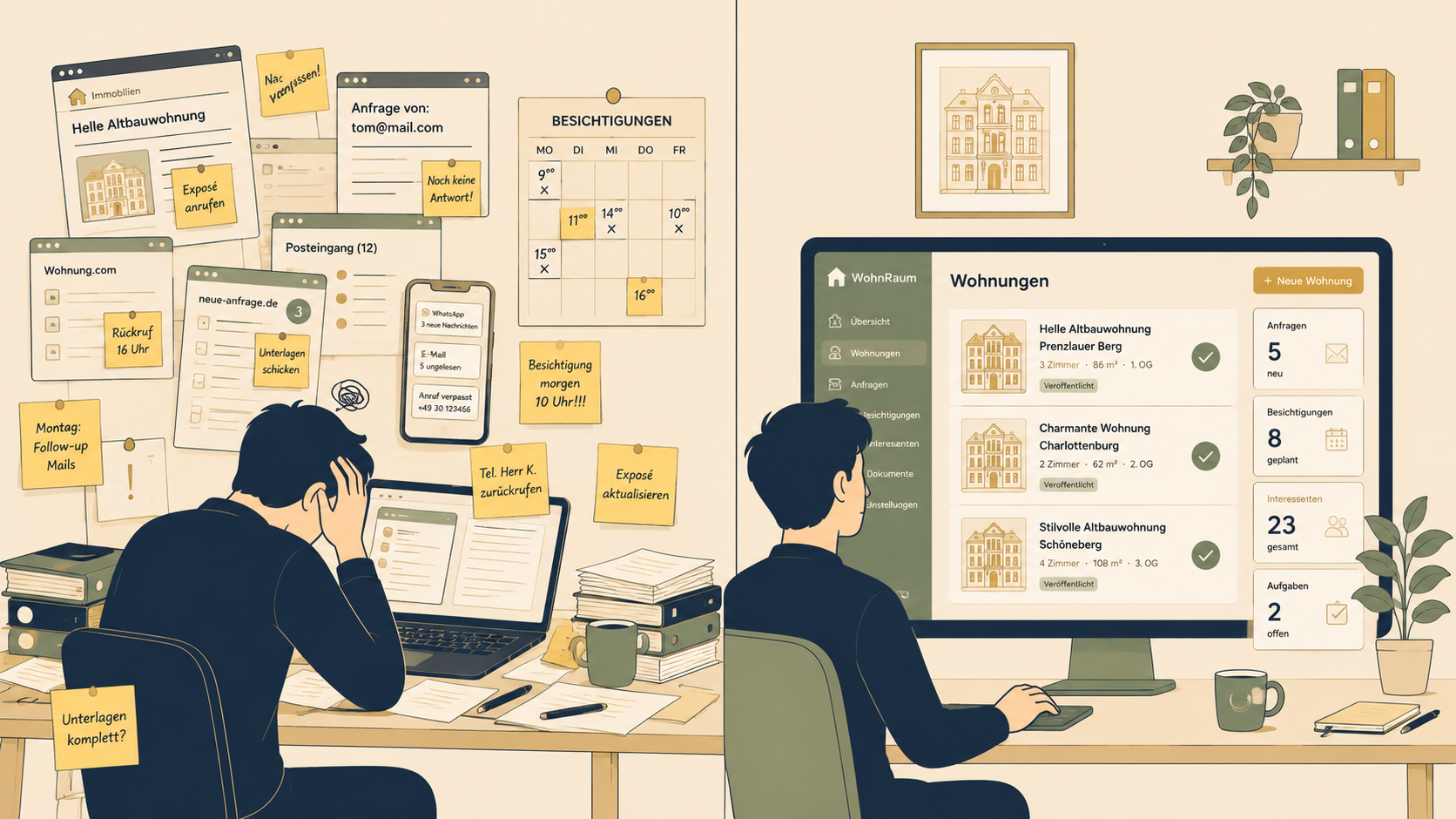
People talk about finding an apartment like it’s a task you fit around your life. Check the apps in the morning, send a few messages, see what comes back. It’s not like that. At least not in Germany, and not in any city where the vacancy rate is under 2%.
Apartment hunting, done properly, is a second job. One with irregular hours, no pay, and a hiring manager who doesn’t have to explain why they picked someone else.
The response window is shorter than you think
A decent apartment in Berlin or Munich can get 200 applications within 24 hours of going live. Some landlords stop accepting applications after the first weekend. By the time you’ve finished reading the listing, three other people have already sent their documents.
This means you can’t batch your apartment search into the evenings. You have to check multiple times a day. You have to have your documents ready to send immediately, not assembled over the next couple of days. The people who get apartments are almost always the ones who responded within two or three hours, not two or three days.
If you’re working a full-time job while searching, that’s a real problem. You can set up alerts. You can step away from your desk to read listings. But if a landlord calls at 2pm on a Tuesday to ask if you can view the apartment Thursday morning, and you can’t make that work, someone else will.
The paperwork doesn’t stay prepared
You gather your documents once, and you feel ready. SCHUFA report, payslips, Mietschuldenfreiheitsbescheinigung from your last landlord, employment contract, bank statement, cover letter explaining who you are.
Then three weeks pass. Your SCHUFA report is now older than some landlords accept. Your most recent payslip is from two months ago and you need three. The cover letter you wrote doesn’t mention the specific apartment you’re applying for now, and the landlord asked for a customized application. You’re not as ready as you thought.
The documents need ongoing maintenance. Not just prepared once and filed away.
Viewings take a full day
A 20-minute viewing takes a full day. Travel there, travel back, the time spent getting ready, the time spent looking up the neighborhood and the specific building beforehand. Then the follow-up email you send the same day to stay top of mind, because showing up and saying nothing afterward is a fast way to get overlooked.
If you’re doing three viewings a week — which is roughly what it takes to have a realistic chance at something — that’s the better part of three days consumed, in addition to everything else.
And viewings are emotionally expensive in a way that’s hard to explain until you’ve done a dozen of them. You walk through an apartment, you imagine living there, you start calculating commutes and grocery stores and whether your furniture fits. Then you get a form email saying the landlord has chosen another applicant. You do it again. After a while, you stop letting yourself get attached, which makes the whole thing feel even more exhausting.
Rejection is the default
Most applications don’t get a response at all. This isn’t rudeness — landlords are sorting through 100 or 200 applications, and responding to each one is genuinely impractical. But it means you have no feedback loop. You don’t know if your cover letter is wrong, if your income ratio is too low for that price range, or if someone simply applied two hours before you with an identical profile and got picked by chance.
You keep applying. You adjust things. You don’t really know if the adjustments helped.
For expats, this is worse. Landlords sometimes prefer tenants with established German credit history, longer work contracts, or who can negotiate in German. These aren’t always conscious biases, just risk calculations, but the effect is that you’re starting at a disadvantage in an already competitive process.
The mental load is the hardest part
Keeping track of what you’ve applied for, which landlords you’ve followed up with, which apartments are no longer available, which neighborhoods you’ve ruled out and why — it accumulates.
After a few weeks, people start making worse decisions. They apply for apartments that don’t fit their requirements because they’re tired of waiting. They skip viewings because they’ve been to too many. They accept terms they weren’t happy with because the search has gone on too long and they need it to end.
The people who find good apartments are usually the ones who managed to stay organized and patient at the same time, for longer than feels reasonable.
What actually helps
Having someone who knows the local market handle viewings on your behalf, especially before you’ve arrived in the country, removes one of the biggest bottlenecks. A relocation agency in Germany can shortlist apartments, attend viewings, and give you a real read on which landlords are responsive and which buildings have issues that don’t show up in listing photos.
Shared tools also help more than people expect. When you’re searching with a partner, or with a relocation agency working on your behalf, having one place where all the listings, notes, and decisions live stops a lot of things from falling through the cracks.
None of it makes the search easy. It just makes it manageable.
Working with a relocation agency? See how Haus Together fits into the process.
About
Haus Together helps expats and relocation agencies collaborate on apartment searches in Germany.
Learn more →